
Over 800,000 calls were made to UK ambulance services in 2024 related to trips, slips and falls, as revealed through Freedom of Information Requests we made to every ambulance service across the country*1 (see Table 1).
Ambulance services attend many different medical emergencies, but slips, trips and falls routinely account for a large proportion — roughly two-thirds of accident-related hospital admissions are due to falls.
While one in three people aged over 65 has a fall at least once a year, falls, trips and slips can happen at any age, whether it’s slipping on ice outdoors, tripping over a loose cable at work or falling off a stool at home.
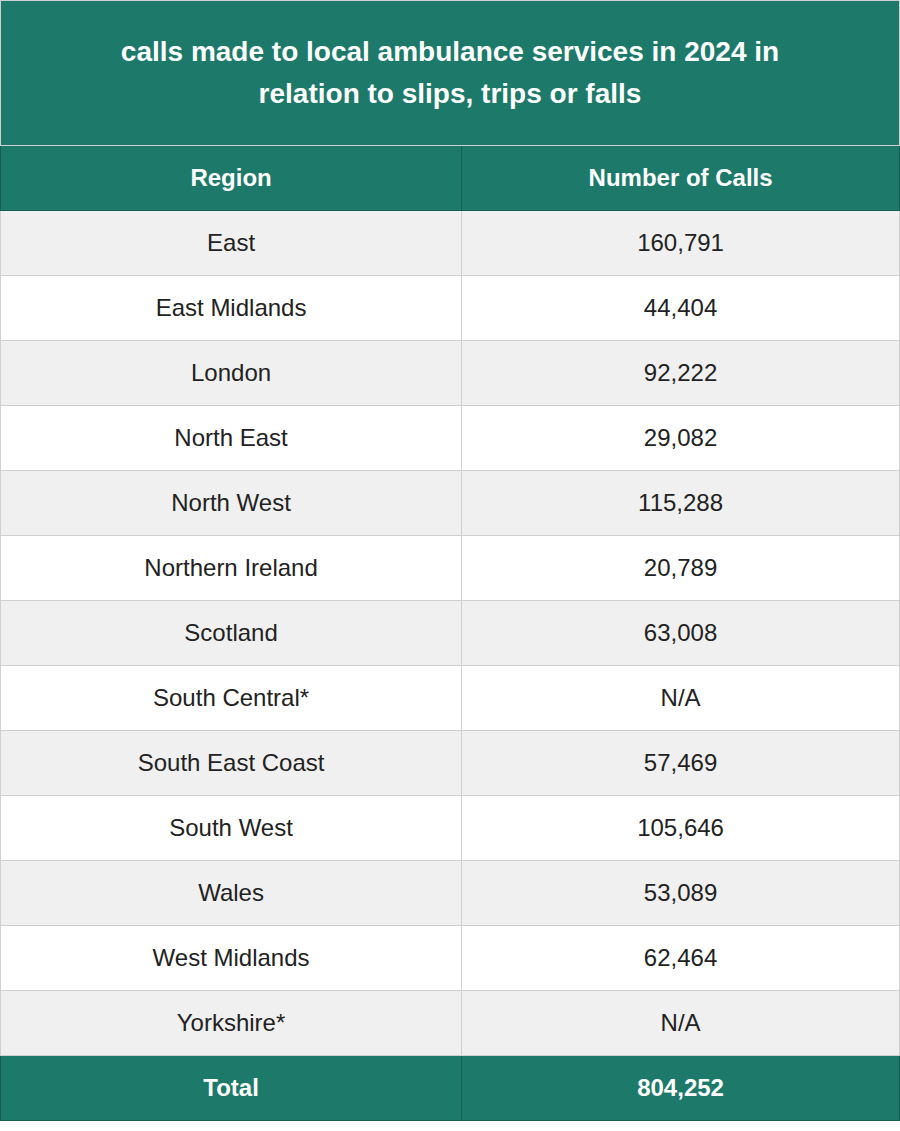
*At the time of writing, we have not received full responses from two of the UK’s 13 ambulance services, namely Yorkshire Ambulance Service and South Central Ambulance Service[
How ambulance calls ranked nationwide
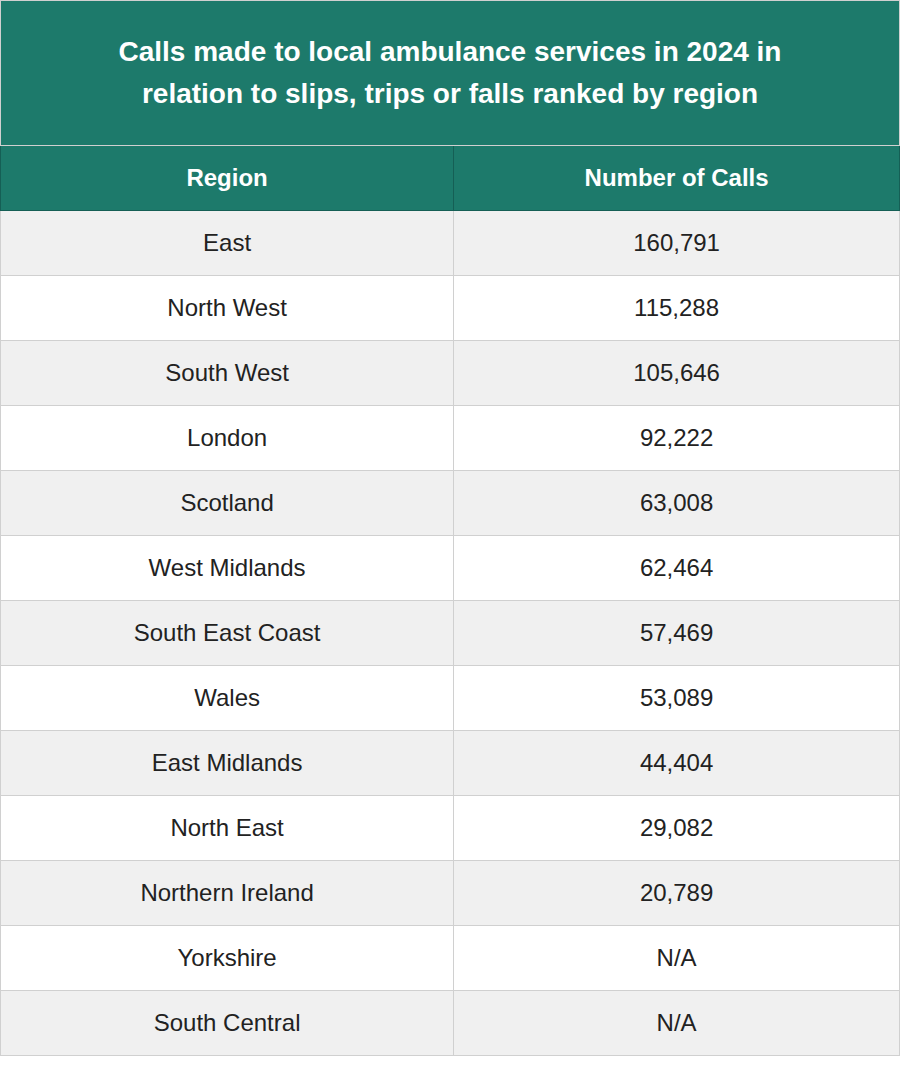
Over 800,000 calls were made to UK ambulance services in 2024 in relation to slips, trips and falls. The East of England topped the rankings with almost 161,000 calls, followed by the North West and South West, with approximately 115,000 and 105,000 calls, respectively (see Table 2).
Meanwhile, the North East and Northern Ireland had the fewest number of calls at 29,082 and 20,789, respectively.
This data was collected throughout the year, and while winter is often associated with the highest risk of falls, there are risks during every season, particularly when outdoors.
Seasonal fall risks
Winter brings icy roads and reduced daylight hours that make visibility outdoors more challenging — both increase the risk of falls. What’s more, the cold weather can stiffen joints and muscles, making it harder to keep your balance.
In contrast, hot summer days increase the likelihood of dehydration, which can cause dizziness and fatigue, making falls more likely.
Spring comes with melting ice and snow, and April showers, creating slippery outdoor surfaces, while leaves carpeting the streets in autumn make it harder to spot trip hazards.
If you see someone fall and are unsure what to do, Consultant Orthopaedic Surgeon at Spire Southampton Hospital, Mark Frame, who has extensive experience treating patients for trauma and knee issues, shares his advice on the best course of action:
“Call 999 immediately if someone loses consciousness, cannot get up, or may have injured their head, neck or hip. Confusion, vomiting, slurred speech or a worsening headache after a fall are red flags and require urgent assessment.
Even if symptoms appear mild, persistent pain or difficulty weight-bearing should not be ignored. In older adults particularly, a fall can sometimes be the first sign of an underlying medical issue. If there is uncertainty, NHS 111 can help determine the most appropriate next step.”
Where are the UK’s fall hotspots?
Ambulance services nationwide, from Aberdeen to London, receive an overwhelming number of calls. Focusing on calls related to slips, trips and falls by region, we calculated how these numbers stack up when compared to the size of the population in each region.
Taking the number of calls made in a given region, this number was divided by the population of the region (according to Statistica) and multiplied by 100,000. This produced the number of calls made per 100,000 people in each region, allowing a fair comparison to be made between regions.
What were the results?
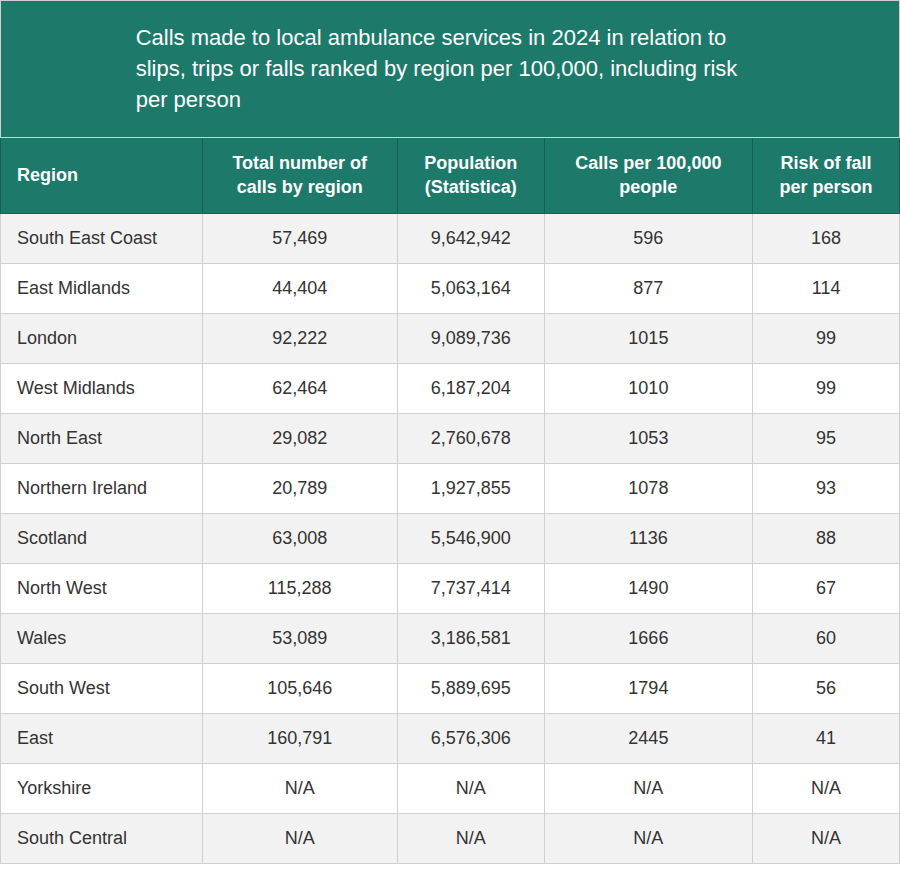
Ranking from highest to lowest, this data reveals that the East of England leads the way by a significant margin with the highest number of calls per 100,000 people, at 2,445 calls, followed by the South West (1,794 calls) and Wales (1666).
In ranking order, the North West, Scotland, Northern Ireland, North East, London and the West Midlands all
The East Midlands and South East Coast had the fewest calls to ambulance services related to trips, slips and falls per 100,000 people,at 877 and 696 calls, respectively.
Do you live in a fall hotspot? We looked at answering this question by taking the total population of a given region and dividing it by the number of calls to ambulance services in 2024 related to slips, trips and falls.
While roughly one in 79 people nationwide*2 are affected by falls that require ambulance services, the risk varies considerably across regions (see Table 3).
Those in the South East Coast have the lowest risk, with approximately one in 168 people in the region calling an ambulance for trips, slips or falls. The East Midlands comes in second lowest with one in 114 people calling an ambulance for trips, slips or falls.
In contrast, the East of England shows the highest risk, with around one in 41 people calling ambulance services due to a trip, slip or fall. The South West and Wales also have a high risk, with one in 56 and one in 60, respectively, being affected by falls that need an ambulance callout.
Over 90 serious falls every hour
Highlighting just how common serious falls are, ambulance service data reveals that in 2024, 91 calls were made every hour nationwide related to slips, trips and falls.
Taking a look at the data by region, the East of England once again ranks highest with 18 calls every hour related to slips, trips and falls. The North West, South West and London were all also in double figures with 13, 12 and 10 calls per hour, respectively.
Scotland, the West Midlands and the South East Coast each recorded 7 ambulance calls every hour related to slips, trips and falls. While call numbers were lowest in the North East and Northern Ireland, serious falls still affected local residents every hour, with 2–3 calls per hour.
Slipping or falling and hurting yourself can have a serious impact on your quality of life. Mark Frame shares more on the most common injuries which occur after a fall and what you can do to limit your risk:
“Most falls result in bruising or sprains, but we frequently see fractures of the wrist, ankle and hip. In older patients, hip fractures are especially concerning as they can significantly impact mobility and independence.
It’s also important to recognise that not all serious injuries are obvious. One of the key injuries we look for after a fall is an occult hip fracture. These do not always show up on an initial X-ray. If someone has ongoing hip or groin pain and is struggling to weight bear, further imaging is often required. In trauma centres, MRI is considered the gold standard for detecting these hidden fractures. Missing one can delay treatment and worsen outcomes.
In younger and more active patients, ligament injuries around the knee or ankle are also common and may require specialist assessment if symptoms persist.
In terms of prevention, maintaining strength and balance is one of the most effective protective measures. Regular activity such as walking, swimming or balance-focused exercises can significantly reduce fall risk. At home, simple steps such as improving lighting, securing loose rugs and wearing appropriate footwear can make a substantial difference.”
Disclaimers
*1At the time of writing, we have not received full responses from two of the UK’s 13 ambulance services, namely Yorkshire Ambulance Service and South Central Ambulance Service.
*2Excluding South Central and Yorkshire, where data from local ambulance services were not available at the time of writing.